
Opinion: Hoboken Loves Dogs. So Why Does It Feel Less Dog Friendly?
- Will Ferman

- May 8
- 13 min read
Updated: May 8

This Town Used To Feel Different
There was a time when Hoboken felt like one of the most dog friendly towns in America.
Not “dog friendly” in the fake luxury apartment marketing sense where a building puts out a water bowl and calls it a day. I mean genuinely dog friendly. A place where dogs were part of the social fabric of the town. You felt it everywhere.
People knew dogs by name before they knew the owners. Neighbors stopped to say hello. Baristas recognized regular dogs walking by the window. Walkers, deli guys, shop owners, everybody knew the local dogs. There was warmth to it. Patience. Community.
It felt like dogs belonged here.
Now something feels different.
The energy around dogs in Hoboken has become colder, more restrictive, more transactional, and honestly, at times weirdly hostile. And before somebody rolls their eyes and says, “Here goes the dog walker complaining again,” hear me out.
I’ve spent over 15 years walking thousands of dogs in this town. Morning to night. Rainstorms. Snowstorms. Heat waves. Holidays. My entire job exists at street level, so I notice patterns most people don’t. I see how dogs live here. I see how owners behave. I see how neighbors react. I see what the culture around dogs has become.
And I genuinely think the quality of life for dogs in Hoboken has declined.
Not overnight. Not dramatically. Just slowly, quietly, in a hundred little ways that add up.
The Housing Culture Has Become Weirdly Anti Dog
One of the clearest examples starts with housing.
More landlords are implementing strict no pet policies. More buildings are adding breed restrictions and weight limits. More renters don’t even want roommates with dogs anymore.
And look, I understand there have to be rules. Nobody wants neglected dogs destroying apartments or barking all night in thin walled buildings.
But somewhere along the line, the pendulum swung too far.
Dogs increasingly feel treated like liabilities instead of living beings that bring warmth, companionship, and emotional value into people’s lives.
The irony is that Hoboken built part of its modern identity around young professionals with dogs. Walk around town and dogs are everywhere. For a lot of people, especially people far from family, their dog is their closest companion.
Yet housing culture has become strangely hostile toward them.
And honestly, some of the breed restrictions are ridiculous.
Many aren’t based on actual temperament or behavior. They’re based on outdated stereotypes and insurance paranoia. Meanwhile I’ve met tiny designer dogs around town causing far more chaos than some of the sweetest “restricted” breeds imaginable.
I’ve personally experienced how absurd this can get.
One day I was walking one of my longtime clients, Lola, a German shepherd, and we entered another residential building to pick up one of her dog friends for a walk. While we were in the elevator, a woman immediately commented that German shepherds were not allowed in the building.
A little later, I got a call explaining that Lola wasn’t allowed inside because German shepherds were on the restricted breed list.
I remember feeling genuinely irritated. Not because I think buildings shouldn’t have rules, but because Lola had never shown aggression toward another dog or person a single time in all the years I’d known her. She was stable, social, and beautifully behaved.
Meanwhile I’ve seen plenty of “approved” breeds around town completely losing their minds at the end of a leash.
Yet Lola was treated like a threat before anybody even knew her.
Honestly, I almost felt angry for her. She had no idea what was going on. She was just happily walking into a building to see her friend.
That moment stuck with me because it perfectly captures what I think is happening culturally. We increasingly judge dogs based on optics, stereotypes, and fear instead of actual behavior and lived experience.
The same thing is happening socially too. People want the aesthetic of living in a dog friendly town without accepting any of the realities that come with sharing space with animals.
Everybody loves seeing golden retrievers on Washington Street until they hear paws on the floor upstairs.
That contradiction says a lot.

Hoboken Keeps Adding Dogs Without Adding Space For Them
Another issue nobody really talks about enough is that Hoboken’s dog population exploded while the actual infrastructure for dogs never kept up.
And no, a tiny fake grass patch on the roof of a luxury building is not infrastructure.
For a town this obsessed with dogs, there are surprisingly few legitimate spaces for them to comfortably exist.
Now to be clear, I’ve made my stance on dog parks public for years. I’m personally not a huge fan of them. I think many are overstimulating, chaotic, and can create behavioral problems depending on the dog.
But even I can acknowledge the obvious reality that if a city encourages massive dog ownership, there should be enough designated outdoor space to support it.
Right now there isn’t.
And some of the spaces that do exist are increasingly being stretched beyond what they were originally intended for.
Public dog parks sometimes function like unofficial daycare overflow zones, with large groups being cycled through them commercially. That creates overcrowding, tension between owners, and more stress on the spaces themselves.
And honestly, some of the giant pack walking around town has gotten a little out of control too.
Again, this is coming from somebody who works in the industry myself, so I’m not saying professional dog walkers are inherently the problem.
But there’s a major difference between thoughtfully walking a small, manageable group of dogs and moving massive overstimulated packs through already crowded urban environments.
Sometimes you’ll see huge groups flooding sidewalks, bottlenecking intersections, or overtaking dog parks in ways that honestly feel more like commercial herd movement than structured dog handling.
And the frustrating part is that it often feels largely unchecked.
Meanwhile ordinary dog owners are constantly being reminded about restrictions, enforcement, and rules, while some extremely high volume dog operations seem to operate in gray areas without much scrutiny at all.
That imbalance contributes to the broader feeling that Hoboken’s dog infrastructure is becoming strained beyond what the town was originally built to handle.
The sidewalks get tighter.
The parks get more crowded.
The dogs get more overstimulated.
And the overall energy around dogs in public spaces becomes more chaotic for everybody.
At the same time, dogs are banned from casually relaxing in many normal public parks throughout Hoboken.
That contradiction is hard to ignore.
Recently, I tried organizing a golden retriever meetup event. Nothing crazy. Just people gathering with their dogs in a wholesome community setting. I was reprimanded by municipal officials and informed that dogs were not allowed in that particular park under the existing rules.
And to be fair, they were technically correct. The rule existed. I respected it.
But it still felt ridiculous.
Because what exactly is the long term vision here?
Hoboken constantly markets itself as a dog town. Dogs are everywhere in branding, apartment marketing, social culture, and local businesses. But when people peacefully gather with dogs outdoors, suddenly it becomes treated like an issue requiring enforcement.
That disconnect is part of the larger problem.
A truly dog friendly city doesn’t just tolerate dogs. It plans for them thoughtfully.
And right now Hoboken feels like a town where dog ownership grew faster than the city’s willingness to meaningfully accommodate it.
Hoboken’s Walkability Is Getting Worse Too
And this part might sound unrelated at first, but I actually think it affects dogs and dog culture more than people realize.
Hoboken feels significantly less walkable than it used to.
It seems like every month another street is closed. There’s always some new construction zone, repaving project, block party, redevelopment project, brownstone gut renovation, utility work, or hot asphalt getting poured somewhere.
At a certain point, it starts affecting the actual rhythm and livability of the town.
And for dogs, that matters.
This is a town fundamentally built around walking. Dogs experience Hoboken through sidewalks, routines, smells, routes, little neighborhood rituals, and daily movement. When entire sections of the town constantly feel chaotic, loud, blocked off, overcrowded, or under construction, it changes the energy dogs absorb every single day.
Half the time now it feels like you’re weaving through barricades, dodging construction crews, rerouting around closed sidewalks, navigating loud machinery, or squeezing dogs through narrow bottlenecks packed with strollers, scooters, delivery bikes, and traffic.
It chips away at the charm of the town.
And honestly, as a dog walker, it gets frustrating.
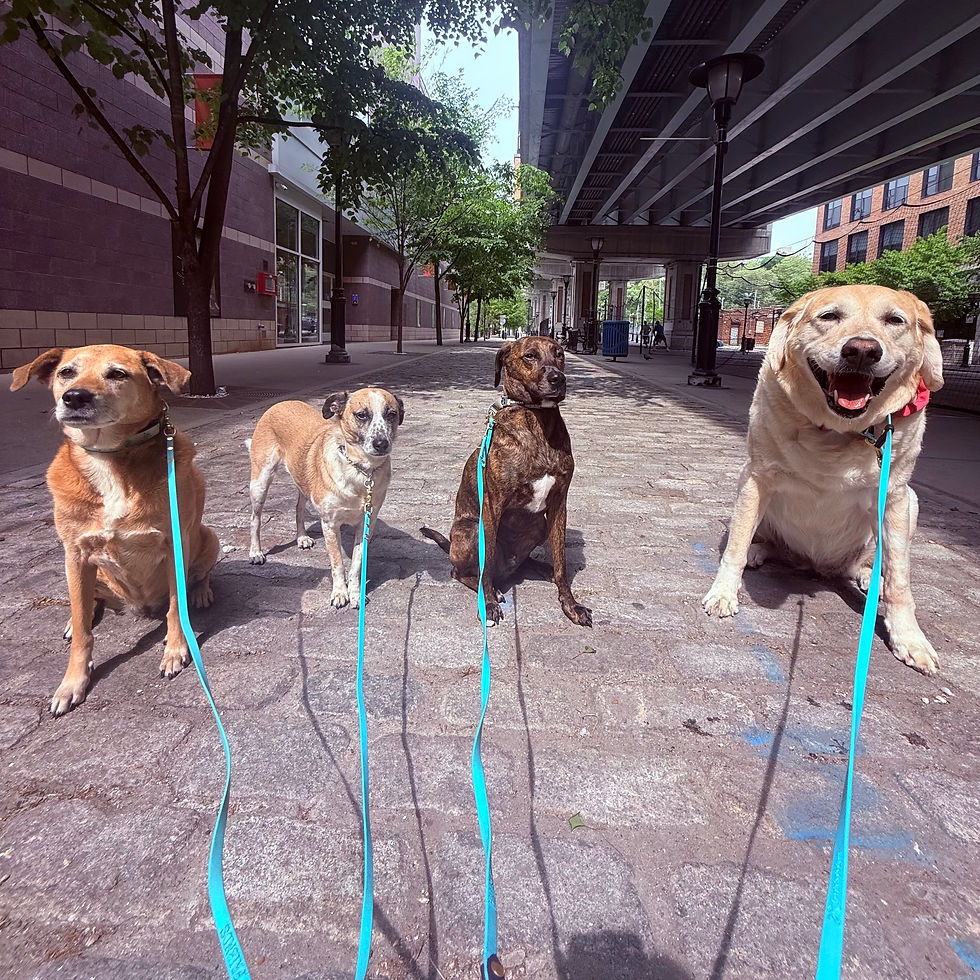
And for the record, I’m not even one of these giant pack walkers moving through town with ten or fifteen dogs at once. I purposely keep my groups small and manageable because I think that’s safer and healthier for the dogs.
But even navigating Hoboken with three or four active dogs nowadays can become overstimulating and stressful depending on the route and what’s going on around you.
Hell, even when I’m walking one of my Great Dane clients by herself, there are moments where the environment feels chaotic. Between jackhammers, blocked sidewalks, speeding scooters, construction crews, delivery bikes flying around corners, and streets constantly being rerouted, it can start to feel less like a relaxing neighborhood walk and more like obstacle course navigation.
A calmer, cleaner, naturally walkable environment tends to create calmer humans and calmer dogs. A constantly overstimulating environment tends to create more tension, frustration, and reactivity.
Again, none of this exists in isolation.
Dogs absorb the emotional atmosphere of the environments they live in.
And lately, Hoboken increasingly feels like a town under nonstop renovation instead of a peaceful neighborhood where people and dogs can comfortably exist together.
Hoboken Has A Training And Behavioral Problem Too
Another uncomfortable reality?
There are reactive dogs everywhere in Hoboken now.
And before people get defensive, I’m not saying every barking dog is “bad.” Reactivity is complicated. Urban environments are hard on dogs, and Hoboken in particular can be incredibly overstimulating.
The streets are narrow. Construction is constant. Sirens never stop. Sidewalks are crowded. Dogs are packed into close proximity with each other all day long.
Then on top of that, many owners are told dogs aren’t allowed in most public parks, meaning thousands of dogs are basically confined to concrete sidewalks with very few natural outlets.
Most people here don’t have backyards.
So where exactly are these dogs supposed to decompress?
A lot of behavioral problems in Hoboken are environmental.
But training and education are still part of the conversation too. Too many people adopt dogs without understanding basic canine psychology, leash handling, boundaries, structure, or consistency.
And honestly, I think Hoboken’s social culture has unintentionally made this worse.
We’ve created this hyper watchful atmosphere where people are terrified of being judged publicly over every interaction with their dog. Everything gets filmed. Everything gets posted. Everything gets debated online by strangers.
There’s this fear that if somebody gives a firm leash correction or uses a stern voice, they’ll immediately be labeled abusive by some random bystander.
To be clear, actual abuse is real and should absolutely be condemned.
But firmness is not abuse. Structure is not abuse. Calmly correcting a dog is not abuse.
Some dogs genuinely need confident handling and clear boundaries, especially in chaotic urban environments like Hoboken.
Ironically, the fear of public judgment often creates the opposite outcome people want. Owners become hesitant, nervous, inconsistent, and passive, and dogs absolutely feel that uncertainty.
Dogs are incredibly perceptive animals. They become more anxious when humans are unclear, emotionally reactive, or afraid to lead.
And honestly, I think this issue became even more noticeable during the work from home era.
Work From Home Culture Changed Dog Ownership Too
Another thing nobody really talks about is how remote and hybrid work culture changed dog ownership in Hoboken.
And not always for the better.
At first, it sounded great for dogs. Humans home more often. Less isolation. More companionship.
In theory, amazing.
But in reality, I think it unintentionally created a lot of passive dog ownership.
A lot of people now simply coexist with their dogs instead of actively engaging them. The dog lays nearby while the owner works on a laptop all day, attends Zoom meetings, scrolls social media, and calls it quality time.
Meanwhile the dog barely leaves the apartment.
You walk around Hoboken now and constantly hear dogs barking behind windows all day long. Dogs pacing apartment ledges. Dogs losing their minds at every passing dog, stroller, skateboard, or delivery driver.
And you have to ask yourself whether these dogs are actually getting enough exercise, stimulation, training, structure, and meaningful outdoor time.
Because proximity is not the same thing as fulfillment.
A healthy dog usually needs movement, novelty, engagement, structure, and opportunities to decompress outside the apartment. Especially in a dense urban environment like Hoboken.
And honestly, I think a lot of people unintentionally started giving their dogs the bare minimum while convincing themselves it was enough because technically they were home all day.
That’s not cruelty.
But it also isn’t ideal dog ownership.

The Poop Problem Is Making Everything Worse
To be fair, not all the blame falls on landlords, buildings, or anti dog residents.
Some dog owners are absolutely making things worse.
The poop situation in Hoboken has become embarrassing.
Too many people don’t pick up after their dogs. Too many people let dogs pee directly in front of businesses without redirecting them. Too many people act like public space is somebody else’s responsibility.
And every abandoned pile of dog poop becomes more ammunition for people who already dislike dogs in the city.
Honestly, the fact that there’s literally an Instagram account dedicated to exposing people who don’t clean up after their dogs tells you everything you need to know.
That should not even need to exist.
We now live in a town where somebody felt compelled to create a public poop surveillance account because enough adults apparently cannot handle bending over for three seconds with a plastic bag.
That’s not a dog problem.
That’s a people problem.
A healthy dog culture requires accountability. Dog ownership comes with an unwritten agreement: your dog gets to participate in public life, and in return, you respect the shared environment around you.
When people stop honoring that agreement, backlash becomes inevitable.
And unfortunately, the responsible owners end up paying for the irresponsible ones.
Dogs Are Increasingly Treated Like Accessories
And here’s another uncomfortable truth nobody really wants to say out loud.
A lot of people in Hoboken now own dogs more for lifestyle branding than companionship.
The dog becomes part of the aesthetic package. Luxury apartment. Matcha latte. Pilates membership. Mini doodle with a pricy leash.
But then the actual responsibilities of dog ownership become inconvenient.
So the dog gets overstimulated daycare five days a week. Or dragged into chaotic environments that stress them out. Or treated like an accessory instead of an animal with actual emotional and physical needs.
Meanwhile the city itself has become more rushed, anxious, isolated, and online.
Dogs absorb that energy too.
One thing I’ve always loved about dogs is that they force humans to slow down. They create conversations between strangers. They make cities feel softer and more human.
But that only works when the culture surrounding them stays healthy.
Hoboken’s Dog Scene Used To Feel More Eclectic
And this last point is admittedly more personal opinion than hard science, but I still think it says something about how dog culture in Hoboken has changed.
When I first started working in this town, the dog population felt far more varied and eclectic.
You’d see everything. Pointers. Beagles. Mastiffs. Huskies. Weird little rescue mutts with mysterious backstories. Maybe even the occasional rare breed like a Thai Ridgeback that made everybody stop and stare for a second.
There was more randomness to it. More personality. More volume of dogs as well.
Now it increasingly feels like the flavor of the week is doodles.
And listen, this is coming from somebody who has doodle clients myself. I have nothing against the dogs individually. Many are sweet, goofy, loving animals.
But I do think the doodle boom says something larger about modern dog culture.
A lot of these dogs are being irresponsibly bred to satisfy aesthetic trends and social demand. The craze often feels less rooted in thoughtful breed stewardship and more rooted in creating the perfect urban lifestyle dog.
Hypoallergenic. Instagram friendly. Approachable looking. Photogenic. Marketable.
Again, this is not an attack on every doodle owner or every doodle dog.
But when an entire town starts becoming visually dominated by one category of highly trend driven designer dogs, you can’t help but feel like some of the organic character of the older dog culture starts disappearing too.
Part of what made Hoboken special years ago was that the dogs reflected the unpredictability and individuality of the people who lived here.
Now sometimes it feels oddly standardized.
Like even the dog population got gentrified.

Hoboken Can Still Be A Great Dog Town
Despite everything I’ve written here, I still think Hoboken is a great place for dogs.
And honestly, I wouldn’t even bother writing any of this if I didn’t care.
This article isn’t coming from bitterness toward the town. It’s coming from frustration because I genuinely want things to improve before more of the culture that made Hoboken special disappears.
Dogs are not some tiny niche part of life here. They are deeply woven into the identity of the town. For many people, dogs are family members, emotional support systems, best friends, routines, and in some cases entire lifestyles and careers.
In my case, dogs became my career and shaped the trajectory of my adult life.
I’ve experienced dog culture not just in Hoboken, but in other cities, states, and parts of the world. And honestly, there are places that simply do this better.
The Upper West Side. Parts of Brooklyn. Certain neighborhoods in Europe.
In those places, dogs feel naturally integrated into everyday life. They are properly celebrated and thoughtfully accommodated instead of constantly treated like liabilities, nuisances, or problems waiting to happen.
You notice it even in small everyday interactions.
Restaurants and cafes around Hoboken have also become stricter about dogs not being allowed inside, even briefly. Sometimes you can’t even quickly step in to grab a mobile coffee order with a calm, well-behaved dog quietly beside you.
And yes, before somebody jumps down my throat, I understand the health code argument. Technically, I know why the rules exist.
But emotionally and culturally, it still creates this feeling that dogs are inconveniences instead of valued parts of public life.
Especially when you travel elsewhere and see different approaches.
In parts of Europe, dogs are naturally integrated into cafes, restaurants, shops, trains, parks, and everyday routines in a way that simply feels more relaxed and normalized. You see calm dogs quietly laying under cafe tables while people eat dinner, and nobody acts like society is collapsing because a golden retriever exists near a croissant.
Obviously there have to be limits. If somebody has a highly reactive dog that struggles heavily around food, crowds, children, or tight indoor environments, then no, that dog probably shouldn’t be inside a packed cafe.
But there has to be some middle ground somewhere.
Because right now, a lot of dog owners increasingly feel like their dogs are being treated as nuisances first and companions second.
Maybe this is just a New Jersey or broader American liability culture thing.
But I still feel the way I feel about it.
I still think there’s a better balance possible.
A truly great dog city finds balance. It encourages accountability from owners while still understanding the enormous emotional and social value dogs bring to urban life. It creates enough space for dogs to exist comfortably instead of squeezing them tighter and tighter into overstimulating environments and then acting surprised when behavioral issues emerge.
Because dogs reflect human culture.
A calm, social, community oriented city usually creates calmer and better socialized dogs. An anxious, hyper regulated, impatient culture often creates anxious and stressed dogs too.
At its best, Hoboken understood that dogs weren’t just tolerated here.
They were part of the soul of the town.
And I still think that version of Hoboken exists underneath all of this somewhere.
I just think we’ve drifted away from it a little.
This article is based on the author’s real world experience and professional observations. AI tools assisted in structuring the article for readability, organization and flow.


